
How Much to Tip Moving Companies
Wondering how much to tip a moving company? Tipping professional movers isn’t required, but it’s a common way to say thank you for the hard physical labor of loading, carrying, and moving your belongings. There’s no hard and fast rule for how much to tip movers, so consider the crew size, hours worked, difficulty of the move, and quality of service when deciding on a dollar amount.
At Stack Moves, we make moving a little easier by delivering reusable plastic moving bins, dollies, and labels right to your door, so you can focus on getting your belongings where they need to go. Our bins arrive pre-assembled, and once you’re finished packing and moving, we pick up the empty bins so you don’t have to deal with a pile of boxes afterward. Whether you’re planning a local move or a long-distance move, we’re here to help make the process simpler. Contact us so we can make your move easier.
This guide breaks down how much to tip movers, including when to tip more, and the factors that can affect what you give each crew member. It’s for anyone planning a local move, long-distance move, or cross-country move who wants a simple way to decide on a fair tip without overthinking it.
Table Of Contents
- How Much Should You Tip Movers?
- How to Calculate a Tip for Your Movers Step by Step
- What Factors Should Determine How Much You Tip Movers?
- How Much Should You Tip Movers for Different Types of Moves?
- Should You Tip Each Mover or Give One Tip to the Crew?
- What Should You Give Movers Besides a Tip?
- Do You Tip Movers If Something Goes Wrong?
- When Should You Tip More or Less?
- How Much Should You Tip Your Movers?
- Frequently Asked Questions
- How Much Should You Tip Movers?
- Is 5% or 10% a Good Tip for Movers?
- How Much Should You Tip Movers for a Local Move?
- How Much Should You Tip Movers for a Long-Distance Move?
- Do You Tip Each Mover Separately?
- Do You Tip Movers Before or After the Move?
- Should You Tip Movers Who Damage Something?
- Do You Tip Movers With Cash or Card?
- Are You Supposed to Feed Movers?
- What If I Can’t Afford to Tip My Movers?
How Much Should You Tip Movers?
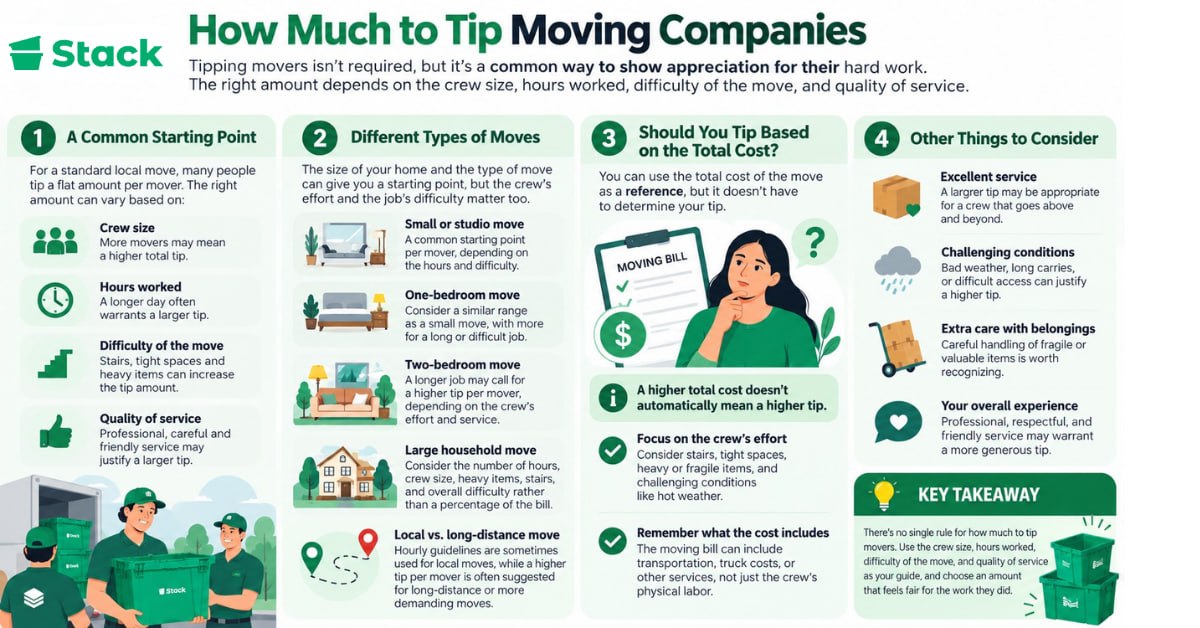
If you’re trying to figure out how much to tip movers, a common starting point is around $20 to $50 per mover for a standard local move, with more for a long day, difficult job, or excellent service. The right amount can vary based on the size of the move, hours worked, number of crew members, and how much heavy lifting or extra effort the job requires.
What Is a Typical Tip for Movers?
For a standard local move, many people use a flat dollar amount per mover rather than calculating the tip as a percentage of the total moving bill. Common guidelines range from about $20 to $50 per mover, while a full-day job may call for around $40 to $100 per mover; hourly approaches can also fall around $4 to $15 per mover per hour.
There’s no single tipping rule that every moving company or customer follows. A flat amount can make more sense for larger moves because the total cost may be high simply because there are more belongings, more hours, or a longer distance involved, even when the crew’s actual effort doesn’t increase in the same proportion.
Should You Tip Based on the Total Moving Cost?
You can use the total cost of the move as a reference, but it doesn’t have to determine your tip. A $10,000 move, for example, doesn’t automatically mean you need to hand the crew a percentage of that amount, especially when the price reflects distance, truck costs, or other moving services rather than just the crew’s labor.
Instead, think about what the movers actually did during the job. If the crew worked through stairs, tight spaces, heavy furniture, fragile items, or hot weather, those factors may justify a larger tip, particularly when the service was professional, and your belongings were handled with care. Your total moving cost can also include different services and circumstances beyond the crew’s physical labor. For interstate moves, the FMCSA explains that written estimates can include transportation, accessorial, and advance charges, which is another reason not to automatically base your tip on a percentage of the final bill.
How Much Should You Tip for Different Types of Moves?
The size of your home and the type of move can give you a starting point, but the crew’s effort and the difficulty of the job matter just as much. Here’s a simple way to think about tipping for different moves:
|
Type of move |
Practical tipping approach |
|---|---|
|
Small or studio move |
Around $20–$50 per mover is a common starting point, depending on the hours and difficulty. |
|
One-bedroom move |
Consider $20–$50 per mover, with more for a long or difficult job. |
|
Two-bedroom move |
A longer job may put you closer to $40–$100 per mover, depending on the crew’s effort and service. |
|
Large household move |
Consider the number of hours, crew size, heavy items, stairs, and overall difficulty rather than simply using a percentage of the total bill. |
|
Local move |
Hourly guidelines such as $4–$15 per mover per hour are sometimes used, while a flat amount per mover can be simpler. |
|
Long-distance move |
$50–$100 per mover is a commonly suggested range, particularly for a demanding move, and you may need to account for both the pickup and delivery crews. |
For long-distance moves and cross-country moves, it’s also worth remembering that the people loading the truck may not be the same crew unloading it at your destination. If you receive good service from both teams, you can plan separate tips for each crew rather than trying to split one amount between everyone.
How to Calculate a Tip for Your Movers Step by Step
There isn’t one tip amount that works for every move, and you don’t need to follow a strict formula to get it right. A simple way to decide how much to tip movers is to look at the crew size, time, difficulty of the job, and quality of service before choosing a fair amount per mover.
Step 1: Count the Number of Movers
Start by counting the people who actually worked on your move. You can decide whether you want to give each crew member a separate tip or calculate one total amount for the entire crew.
Step 2: Consider How Long the Move Took
Think about whether the movers worked for a few hours, most of the day, or across two days. A long day usually means more time and physical effort, which may be a reason to move toward the higher end of your tipping range.
Step 3: Consider the Difficulty of the Move
Look at what the crew had to deal with during the job. Stairs, heavy furniture, tight spaces, narrow hallways, difficult parking, multiple stops, fragile or specialty items, and hot or bad weather can all make a move more demanding.
Step 4: Assess the Quality of Service
Consider how the movers handled the job from start to finish. Were they punctual, professional, careful with your belongings, efficient, and helpful? Good communication and extra effort can also make a higher tip feel appropriate.
Step 5: Choose a Tip Per Mover
Once you’ve considered these factors, choose a dollar amount per mover instead of automatically applying a percentage to the total moving cost. This keeps the calculation simple and gives you room to adjust the tip based on the actual service you received.
Step 6: Multiply by the Crew Size
Multiply the amount you chose per mover by the number of people on the crew. For example, if you decide on $40 per mover and three movers work on your job, your total tip would be $120, with $40 going to each person.
Step 7: Give the Tip After the Move
It’s usually easiest to wait until the job is finished before deciding on the final tip. Once you’ve seen the full level of service, you can give each crew member their cash tip individually or provide one group tip and let the crew decide how to split it.
What Factors Should Determine How Much You Tip Movers?

The amount you tip should reflect what the crew dealt with during the move, not just the size of your moving bill. A few extra factors can help you decide whether your tip should stay around the usual range or go a bit higher.
How Difficult Was the Move?
Some moves simply require more physical work than others, and that’s worth considering when deciding on your tip. Multiple flights of stairs, walk-up buildings, heavy furniture, narrow hallways, long carries, difficult parking, multiple stops, and specialty items can all add extra time and effort.
If the crew handled those challenges without making the process harder for you, a larger tip can be a good way to recognize the extra work involved. The same goes for moves where movers have to carefully handle bulky or fragile items that require more attention than everyday boxes.
How Long Did the Move Take?
Time is another simple way to gauge the effort involved. A short move that takes a few hours is different from a half-day or full-day job, while a long-distance move that takes two days or more can require considerably more time and physical work.
That doesn’t mean you have to calculate your tip strictly by the hour. Instead, use the length of the job as one factor alongside the difficulty of the move and the service you received.
How Was the Service?
The quality of service matters just as much as the physical demands of the job. Think about whether the movers arrived on time, communicated clearly, treated your belongings with care, worked efficiently, and remained professional throughout the move.
If the crew went beyond what you expected, such as helping with an awkward piece of furniture or taking extra care with fragile items, you may want to tip toward the higher end of your range. On the other hand, poor communication, careless handling, or repeated delays may affect how much you ultimately choose to give.
How Much Should You Tip Movers for Different Types of Moves?
The right tip can look different depending on whether you’re moving a few pieces of furniture across town or an entire household across the country. Use the type of move as a starting point, then adjust for the crew size, time, physical effort, and quality of service you received.
How Much to Tip Movers for a Local Move
For a local move, a common starting point is $20 to $50 per mover, with the amount adjusted depending on how long and difficult the job is. A smaller move that takes a few hours may stay toward the lower end, while a larger household move with stairs, heavy furniture, or a long day of work may call for more.
Your crew size matters, too. If four movers spend a full day loading and carrying your belongings, for example, you’ll need to budget for four individual tips rather than treating the crew as one person.
How Much to Tip Movers for a Long-Distance Move
Long-distance moves often involve longer working periods, more planning, and heavier demands on the crew, so $50 to $100 per mover is a commonly suggested range. For a particularly demanding long-distance or cross-country move, you can adjust the amount based on the effort involved rather than automatically using a percentage of the total moving cost.
Also, check whether the same crew is handling the entire job. If one team loads your belongings and another team unloads them at the destination, you can give separate tips to each crew based on the service they provide.
How Much to Tip Movers for a Small Move
A studio apartment, single-room move, or furniture-only move may require less time and labor than a full household move. In these cases, $20 to $50 per mover can be a reasonable starting point, with the final amount depending on how many hours the job takes and whether the crew has to deal with stairs, tight spaces, heavy items, or other challenges.
Even a small move can involve hard physical labor, so don’t judge the tip by the number of boxes alone. Moving a few large pieces of furniture through a walk-up building can take considerably more effort than moving several lightweight boxes from an easily accessible home.
How Much to Tip Movers for a Large Move
A large move usually means more furniture and boxes, a larger crew, and more hours of loading and carrying. You can start with the usual per-mover amount and increase it when the job involves significant heavy lifting, multiple flights of stairs, difficult access, fragile items, or a particularly long day.
For example, if five movers work throughout a full day and you feel $60 per person reflects the effort and service, that would make your total tip $300. The point is not to find a perfect formula, but to choose an amount that fairly reflects what the crew actually put into the job.
Should You Tip Each Mover or Give One Tip to the Crew?

A quick comparison will make this easier because there’s more than one way to tip a moving crew. What matters most is making sure the people who did the work actually receive the amount you intended for them.
|
Tipping Method |
Best For |
What to Consider |
|---|---|---|
|
Individual tip |
Straightforward crews |
Give each mover their own amount so everyone receives their tip directly. |
|
Group tip |
Small, consistent crews |
Give one total amount to the crew, but make sure it is divided fairly among the team. |
|
Digital tip |
Companies that accept electronic payments |
Check with the moving company beforehand to confirm whether digital tipping is available and how it is distributed. |
|
Cash tip |
Most situations |
Cash is a simple option, so prepare enough money ahead of moving day if you plan to tip this way. |
When Should You Give Movers Their Tip?
The easiest time to give movers their tip is after the move is complete, when you’ve had a chance to see how the entire job went. Check your belongings, consider how the crew handled the heavy lifting and other challenges, and then assess the overall service before deciding on the final amount.
If you’re happy with the work, you can hand each crew member their cash tip directly or give the group one amount to divide. For a long-distance move where different crews handle pickup and delivery, wait until each crew finishes its part of the job before tipping them.
What Should You Give Movers Besides a Tip?
A cash tip is one way to show your appreciation, but a few thoughtful extras can make a long moving day more comfortable for the crew. More importantly, preparing your home and belongings before the movers arrive can help the entire job run more smoothly.
Should You Provide Food and Drinks?
Keeping cold water and other refreshments available is a simple way to look after movers during a physically demanding job, especially in hot weather or during a long day. Snacks can also be appreciated, and if the move runs through lunch or dinner, you may choose to offer a meal, but food and drinks are thoughtful extras, not a required replacement for a cash tip.
If you do offer food, it’s worth asking about dietary restrictions before ordering a meal. Something as simple as water, sports drinks, snacks, or lunch can be a nice gesture, but you don’t need to feel responsible for providing a full restaurant meal.
How Can You Make Moving Day Easier for Your Movers?
One of the best things you can do for your moving crew is have your belongings packed and ready before they arrive. Label boxes clearly, keep pathways and doorways clear, arrange parking and building access ahead of time, and have the right moving supplies ready so the crew can get straight to work. The Federal Motor Carrier Safety Administration (FMCSA) also recommends preparing ahead of moving day, including being present to answer questions, giving the movers directions, and checking your belongings before the truck leaves.
Stack Moves can help with that preparation by providing reusable plastic moving bins, labels, and dollies that make it easier to organize your belongings before moving day. The bins arrive pre-assembled, and once you’re finished with them, Stack picks them up, giving you one less thing to deal with after the move. Explore Stack Moves reusable moving bins.
Do You Tip Movers If Something Goes Wrong?
Not every moving job goes perfectly, and you don’t have to decide on a tip before you know how the entire experience went. If something goes wrong, separate the question of tipping from any issue involving damage, delays, or poor service.
What If the Movers Damage Something?
If movers damage your furniture or other belongings, tipping and making a damage claim are separate issues. Take photos of the damage, keep any relevant paperwork, and contact the moving company through its claims or customer-service process to find out what steps to follow. For interstate moves, the FMCSA recommends noting damaged or missing items on the inventory before signing your delivery documents and understanding your mover’s liability coverage.
You can still decide whether to tip based on the service you received, but you don’t need to use a tip as a way to settle a damage dispute. If the crew handled your belongings carefully, but an item was accidentally damaged, you may view that differently from a situation where the crew was consistently careless.
What If the Movers Were Late or Unprofessional?
A tip is meant to show appreciation, so you’re not obligated to give one simply because a moving company completed the job. If the movers were significantly late, careless with your belongings, difficult to communicate with, or otherwise unprofessional, consider the overall service before deciding whether and how much to tip.
On the other hand, if there was a genuine delay outside the crew’s control, but they kept you informed and still provided excellent service, you may want to take that into account rather than judging the entire job by one problem. The goal is to tip based on the experience you actually received, not because you feel pressured to do so.
When Should You Tip More or Less?
There’s no need to overthink tipping, but the details of your move can help you decide whether to stay around your usual amount or adjust it. Think about how hard the crew worked, how they handled the challenges, and whether the service matched what you expected.
When a Higher Tip May Make Sense
A higher tip can make sense when the movers put in extra effort or delivered excellent service. Difficult access, multiple flights of stairs, heavy or specialty items, challenging weather, and other unexpected obstacles can make a job much more demanding.
You may also want to tip more when the crew goes beyond the agreed moving services, such as taking extra care with fragile items, finding a way to handle difficult furniture, or helping solve an unexpected problem. If they were punctual, professional, careful with your belongings, and efficient throughout a long day, those are also good reasons to consider the higher end of your range.
When You May Tip Less or Not at All
You’re not required to give a tip when the service falls seriously short of what you expected. Careless handling of your belongings, serious unprofessional behavior, poor communication, or major unresolved service problems may all be reasons to reduce the amount or decide not to tip.
A single small problem doesn’t necessarily have to define the entire experience, though. If the crew worked hard and provided good service overall, consider the full job before making your final decision.
How Much Should You Tip Your Movers?
Tipping your movers is optional, so there’s no single amount you have to give. When deciding how much to tip, look at the effort involved, how difficult the move was, and the quality of service you received, rather than simply basing it on your total moving bill. A crew that handles heavy lifting, stairs, tight spaces, or a long day with care and professionalism may deserve a little more.
You can also make moving day easier by having your belongings packed, labeled, and organized before the crew arrives. Stack Moves provides reusable moving bins, labels, and dollies to help keep your packing process organized without relying on piles of disposable boxes. Ready to make packing easier? Book your reusable moving bins with Stack Moves today.
Frequently Asked Questions
If you’re still unsure about tipping, these quick answers cover some of the questions that commonly come up before moving day.
How Much Should You Tip Movers?
A common starting point is $20 to $50 per mover for a standard local move, while a full-day or especially difficult job may warrant $40 to $100 per mover. Use the crew’s effort, the length and difficulty of the job, and the quality of service to decide where your tip should fall.
Is 5% or 10% a Good Tip for Movers?
A 5% or 10% tip can be used as a reference, but it isn’t a mandatory industry rule. For expensive moves, a flat amount per mover may make more sense because the total moving cost can reflect distance, truck costs, and other expenses that don’t necessarily mean the crew did proportionally more work.
How Much Should You Tip Movers for a Local Move?
For a local move, $20 to $50 per mover is a common starting range. You can adjust that amount based on the number of hours, stairs, heavy furniture, difficult access, and overall service.
How Much Should You Tip Movers for a Long-Distance Move?
For long-distance moves, $50 to $100 per mover is a commonly suggested range. If different crews handle loading and unloading, consider tipping each crew separately based on the work they completed.
Do You Tip Each Mover Separately?
You can, and giving each crew member their own tip is a straightforward way to make sure everyone receives their share. You can also give one group tip, but make sure the crew knows how much it is and that it will be divided fairly.
Do You Tip Movers Before or After the Move?
It’s generally best to wait until the move is complete. That gives you a chance to assess the overall service, check your belongings, and decide on the final tip based on how the crew handled the job.
Should You Tip Movers Who Damage Something?
Tipping and damage claims are separate issues. Document any damage and contact the moving company through its customer-service or claims process, then decide whether to tip based on the overall service you received.
Do You Tip Movers With Cash or Card?
Cash is a simple and commonly preferred option, particularly when you want to give each mover their tip directly. If you prefer to tip by card or electronically, check with the moving company beforehand to make sure that option is available and find out how the money is distributed.
Are You Supposed to Feed Movers?
You don’t have to provide a meal, but water, refreshments, and snacks can be thoughtful extras during a long or physically demanding move. If the job runs through lunch or dinner, you can offer food if you want, but providing food does not replace a monetary tip.
What If I Can’t Afford to Tip My Movers?
Don’t feel pressured to spend money you don’t have just because tipping is customary. If you can’t afford a cash tip, you can still show your appreciation with cold water, snacks, a meal, or simply a sincere thank-you for the crew’s hard work.
Rent Plastic Bins for Your Move!
Moving with cardboard boxes is a pain. Get pre-assembled bins delivered to your door and move hassle-free with Stack!
Stack eliminates the need for you to source, break down, or fill up your trash can with cardboard boxes.